

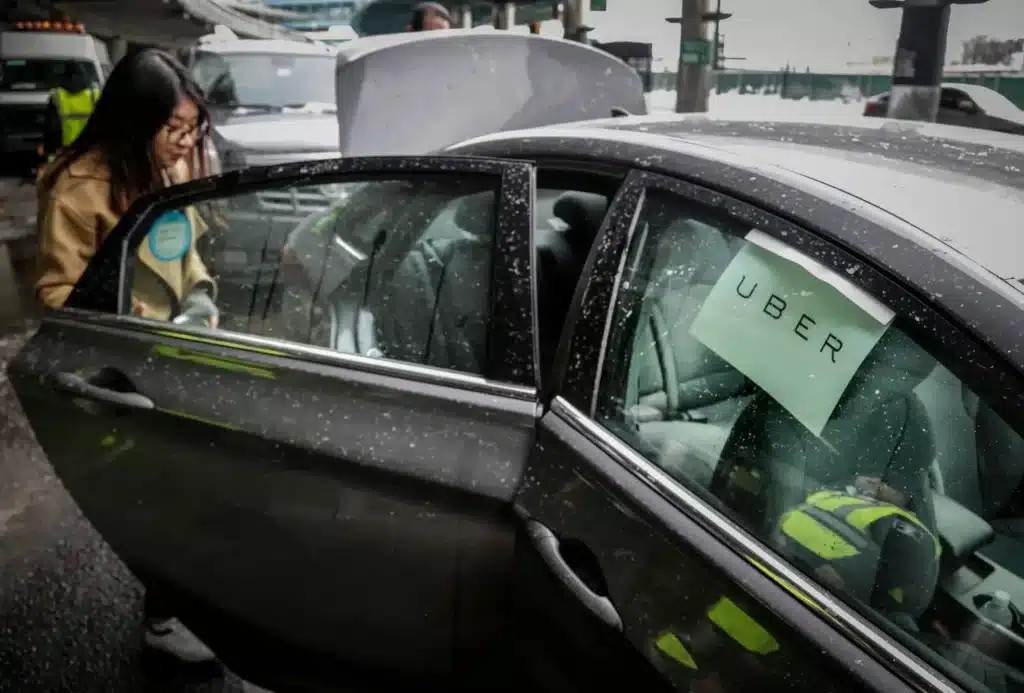
An Illinois rideshare accident lawyer helps passengers, other drivers, pedestrians, cyclists, and rideshare drivers recover after an Uber or Lyft crash. Under the Transportation Network Providers Act (625 ILCS 57/10), the insurance available depends on what the driver’s app showed at the moment of the crash, and the strongest claims start with the trip record, the police report, and prompt medical care.

Table of Contents
How much insurance must Uber and Lyft carry in Illinois?
The Transportation Network Providers Act, 625 ILCS 57/10, sets coverage in two periods. From the moment a driver logs on until the driver accepts a ride request, and again between trips, the driver must be covered for at least $50,000 for death and personal injury per person, $100,000 per incident, and $25,000 for property damage. The rideshare company must maintain contingent coverage in those amounts if the driver’s own policy excludes the trip or falls short.
From the moment a driver accepts a ride request until the trip is complete, primary liability coverage of $1,000,000 for death, personal injury, and property damage applies. That coverage may come from the driver’s policy, the company’s policy, or a combination. The statute also says the $1,000,000 coverage may not depend on a personal auto insurer first denying the claim, and that if the driver’s insurance has lapsed, the company must provide the required coverage from the first dollar.
| App status | Minimum liability coverage | Who usually pays |
|---|---|---|
| App off | Driver’s personal policy only | Driver’s own insurer |
| Logged in, waiting for a request | $50,000 per person / $100,000 per incident / $25,000 property | Driver’s policy, with company contingent coverage |
| Ride accepted through end of trip | $1,000,000 primary; $50,000 UM/UIM for passengers | Company policy or a driver policy meeting the same limits |
Is there uninsured motorist coverage for rideshare passengers?
Yes. During the trip period, the required coverage must include $50,000 in uninsured and underinsured motorist coverage from the moment a passenger enters the vehicle until the passenger exits (625 ILCS 57/10(c)(2)). That matters when a different driver causes the crash and has no insurance or too little. Your own auto policy may also provide uninsured or underinsured motorist coverage, and an Illinois rideshare accident lawyer will review every policy that may stack or apply in order.
What if the rideshare driver’s app was off?
If the app was off, the driver was a private motorist, and the rideshare company’s coverage generally does not apply. The claim then runs against the driver’s personal policy and, if that is not enough, against your own uninsured or underinsured motorist coverage. Disputes about app status are common, which is why the trip receipt, the driver’s screenshots, and the company’s data often decide which insurer must respond.
What evidence matters most after an Uber or Lyft crash?
Illinois requires rideshare companies to send an electronic receipt after each trip listing the origin and destination, the time and distance, and the fare, and to show the driver’s photo and license plate before the passenger gets in (625 ILCS 57/30). Save those screens right away. Other evidence includes:
- The police crash report number from the responding agency
- Photos of both vehicles, the plates, and the scene
- In-app messages with the driver and the incident report you filed
- Names and contact details of witnesses and other passengers
- Emergency room and follow-up treatment records
- Nearby business, bus, or traffic camera video
Phone and app data can show whether a driver was distracted. A lawyer can send preservation requests and, once a case is filed, subpoena the company for trip, GPS, and speed data.
What should a rideshare passenger do in the first 48 hours?
- Get medical care and tell the provider you were in a vehicle crash
- Make sure police come to the scene and write down the report number
- Screenshot the trip receipt, the driver profile, and the plate before closing the app
- File the in-app incident report, keeping it short and factual
- Photograph your injuries and the inside of the vehicle
- Keep every message from the rideshare company and its insurer
Insurers for rideshare companies often call quickly and ask for a recorded statement. You are generally not required to give one to another party’s insurer, and it is wise to wait until you know which policy applies. An Illinois rideshare accident lawyer can handle those calls and send preservation requests for trip and GPS data while it still exists.
Who can be responsible for a rideshare crash?
The driver who caused the crash is the main defendant, whether that is the rideshare driver or another motorist. The rideshare company may also be responsible in some cases. Under 625 ILCS 57/15, a company must run criminal background and driving history checks and may not allow drivers with certain recent violations or convictions on its platform. When a company ignores those rules or prior complaints, its own conduct can become part of the case.
Do I have to arbitrate a claim against Uber or Lyft?
Sometimes. Uber’s U.S. terms require individual arbitration of many disputes, including injury claims connected to a user’s own use of the app. But courts look closely at whose agreement applies to which claim. In Geller v. Uber Technologies, Inc., 2026 IL 132066, the Illinois Supreme Court held that a widow’s own Uber agreement did not force the estate’s wrongful death claims from her husband’s ride into arbitration. Claims against the at-fault driver are a separate question from claims against the company.
Does not wearing a seat belt hurt a passenger’s claim?
No. Under 625 ILCS 5/12-603.1(c), failing to wear a seat belt shall not be considered evidence of negligence, shall not limit an insurer’s liability, and shall not diminish any recovery for damages arising from the operation of a motor vehicle. Insurers sometimes raise seat belts anyway, and the statute answers that argument. The same rule applies whether the passenger was in the back seat of an Uber, a Lyft, or a shared ride with other riders.
Where are Illinois rideshare cases filed and how long do I have?
Most Illinois injury lawsuits must be filed within two years under 735 ILCS 5/13-202, and claims involving a local public entity, such as a CTA bus, have shorter limits. Cases are generally filed where the crash happened or where a defendant resides. Chicago crashes are usually heard in the Circuit Court of Cook County, and our Chicago Uber and Lyft accident lawyers handle crashes from O’Hare and Midway to River North and Wrigleyville. Suburban crashes are often heard in a Cook County district courthouse, as explained on our suburban Cook County rideshare page.
Brand-specific questions are covered on our Uber accident and Lyft accident pages. The Transportation Network Providers Act is currently scheduled for repeal on September 1, 2028 (625 ILCS 57/34), so an Illinois rideshare accident lawyer will check the version of the law in effect on the date of your crash.
Frequently asked questions
How much insurance must Uber and Lyft carry in Illinois?
Under 625 ILCS 57/10, a driver logged in and waiting for a request must be covered for at least $50,000 per person, $100,000 per incident, and $25,000 for property damage. From accepting a ride until the trip ends, $1,000,000 in primary coverage applies.
Is there uninsured motorist coverage for rideshare passengers?
Yes. During a trip, the required coverage includes $50,000 in uninsured and underinsured motorist coverage from the moment the passenger enters the vehicle until the passenger exits.
What if the driver’s app was off?
The rideshare company’s coverage generally does not apply. The claim usually runs against the driver’s personal auto policy and, if needed, your own uninsured or underinsured motorist coverage.
Do I have to arbitrate a claim against Uber or Lyft?
Sometimes. Rider terms often require individual arbitration of claims tied to your own use of the app, but courts look closely at whose agreement applies to which claim.
Does not wearing a seat belt reduce my recovery?
No. Under 625 ILCS 5/12-603.1(c), failing to wear a seat belt is not evidence of negligence and does not diminish any recovery for damages.
What does it cost to hire an Illinois rideshare accident lawyer?
The consultation is free, and there is no fee unless there is a recovery.
Talk with an Illinois rideshare accident lawyer
The consultation is free, and there is no fee unless there is a recovery.
Call (312) 262-3971 any time, 24 hours a day, or contact us online for a free consultation.
Mixan Mahony, LLC
444 W. Lake St., Suite 1707
Chicago, IL 60606
Phone: (312) 262-3971
Get directions to our Chicago office on Google Maps
Past clients: if our team helped you, you can share your experience on our Google Business Profile. Please do not include private medical or case details in a public review.
Attorney advertising. This page is general information about Illinois law, not legal advice, and reading it does not create an attorney-client relationship. Past results do not guarantee a similar outcome.


