

Last updated on November 10, 2026 by Mac Mahony
Motorcycle accidents in Illinois are judged under the same negligence rules as any crash, but riders start at a disadvantage: police, adjusters, and jurors often assume the motorcyclist was speeding. Mixan Mahony, LLC recently recovered a $1,250,000 policy-limits settlement for a Bartlett motorcyclist whom police had placed at fault. This guide explains how fault, insurance, injuries, and deadlines work in motorcycle accidents in Illinois, and what you can do right now to protect your claim.
Table of Contents
Our $1,250,000 Bartlett motorcycle case
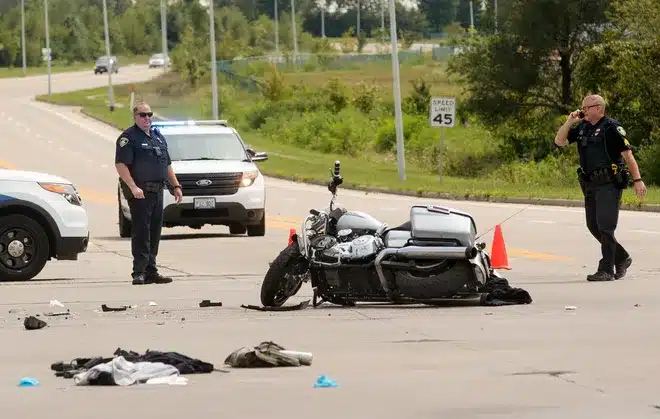
A pickup truck turned left across our client’s path in Bartlett, Illinois. Our client was thrown from his motorcycle. He suffered a traumatic brain injury (TBI), wrist fractures, and fractures to his right foot and ankle, injuries that changed his life.
The responding officers placed our client at fault, citing excessive speed. Insurance companies lean on police reports like this one to deny valid motorcycle claims. Partner Mac Mahony knows a police report is never the final word in an Illinois personal injury claim, so the firm launched an independent crash reconstruction to establish what really happened and who was responsible. The insurer paid the full $1,250,000 policy limits.
Past results do not guarantee a similar outcome. Every case depends on its own facts.
Why left-turn crashes cause so many motorcycle accidents in Illinois
A driver turning left must yield to oncoming traffic that is close enough to be an immediate hazard (625 ILCS 5/11-902). Motorcycles are narrow and easy to misjudge, so drivers often turn into a rider they “never saw.” That is exactly what happened in our Bartlett case.
What defenses do drivers raise in a left-turn motorcycle accident?
- “The rider was speeding.” This is the most common defense, and it is often based on a guess. Crush damage, skid and scrape marks, video, and reconstruction math can test it.
- “The motorcycle came out of nowhere.” A rider in plain view with a headlight on does not appear from nowhere. Sight-line measurements often show the driver had time to see the bike.
- “The sun or traffic blocked my view.” Glare or an obstruction can make the duty to wait stronger, not weaker.
Why do riders face bias after motorcycle accidents in Illinois?
Many people picture motorcyclists as reckless. That stereotype can shape an officer’s first impression at the scene, an adjuster’s valuation, and a juror’s view of the evidence. Strong, objective proof such as reconstruction, video, and independent witnesses is the best answer to that bias.
Other common causes of motorcycle accidents in Illinois
Left turns are only one of the ways drivers cause motorcycle accidents in Illinois. Other common causes include:
- Unsafe lane changes. Drivers must stay within a single lane and may not move out of it until they have made sure the move is safe (625 ILCS 5/11-709). A motorcycle in a blind spot is still in plain view of a careful driver.
- Following too closely. A driver may not follow another vehicle more closely than is reasonable and prudent (625 ILCS 5/11-710). Rear-end impacts that a car would absorb can throw a rider from the bike.
- Distracted driving. A driver looking at a phone can miss a motorcycle entirely.
- Impaired driving. A driver who chooses to drive drunk or high can be held civilly responsible, separate from any criminal case.
- Dangerous road conditions. Potholes, gravel, uneven pavement, and debris are far more dangerous on two wheels. Claims against a government body carry short deadlines.
Whatever the cause, the same rule applies: the rider has to prove the other party was negligent, and the evidence collected in the first days after a crash often decides the claim. Our Illinois motorcycle accident lawyers start that work right away.
How does comparative fault affect motorcycle accidents in Illinois?
Illinois follows modified comparative fault under 735 ILCS 5/2-1116. You are barred from recovery only if you are found more than 50% at fault, and any award is reduced by the rider’s share. For example, if your damages are $400,000 and a jury finds you 20% at fault, you would recover $320,000.
When more than one defendant is responsible, 735 ILCS 5/2-1117 makes every liable defendant jointly and severally liable for your medical expenses, and any defendant 25% or more at fault jointly and severally liable for your other damages. This is why insurers push so hard to shift fault onto the rider.
What injuries are common in motorcycle accidents in Illinois?
Motorcycle accidents in Illinois cause more severe injuries than most car crashes, because riders have no steel frame, seat belt, or airbag. Even a low-speed impact can cause serious harm. These are the injuries we see most often.
What is a traumatic brain injury (TBI)?
A TBI is damage to the brain caused by a blow or violent jolt to the head. Symptoms can include headaches, memory problems, mood changes, and trouble concentrating. Some symptoms appear days later, so imaging, neurological evaluation, and careful documentation matter.
How do spinal cord and back injuries affect a claim?
Herniated discs, vertebral fractures, and spinal cord injuries can require surgery and long-term care, and can limit the ability to work. Future medical costs and lost earning capacity are often the largest parts of these claims.
Why are fractures so common for riders?
Riders instinctively reach out to break a fall, and legs are exposed to direct impact. Wrist, ankle, foot, leg, and collarbone fractures are common, as they were in our Bartlett case.
Is road rash a serious injury?
Yes. Deep road rash can cause infection, nerve damage, and permanent scarring that may need skin grafts. Disfigurement is a separate category of damages under Illinois law.
What happens when a crash leads to amputation?
An amputation changes every part of daily life. A claim should account for prosthetics and their replacement over a lifetime, home and vehicle modifications, therapy, lost income, and loss of a normal life.
Does Illinois require motorcycle helmets?
No. Illinois has no general helmet requirement for adult riders, and local governments, including home rule units, may not pass ordinances requiring motorcycle users to wear protective headgear (625 ILCS 5/11-208(e)). Riders and passengers must, however, use glasses, goggles, or a transparent shield (625 ILCS 5/11-1404).
Can an insurer use a missing helmet against me?
Not wearing a helmet does not by itself bar a claim, and it has nothing to do with who caused the crash. An insurer may still argue that a helmet would have reduced a head injury. Medical and biomechanical evidence can answer that argument, and it has no bearing on fractures or other injuries a helmet would not prevent.
What insurance pays after motorcycle accidents in Illinois?
After motorcycle accidents in Illinois, the at-fault driver’s liability policy usually pays first. If that coverage is too small or missing, your own uninsured or underinsured motorist coverage may help.
What are the Illinois minimum liability limits?
Illinois requires at least $25,000 for bodily injury or death of one person, $50,000 for two or more people, and $20,000 for property damage in any one crash (625 ILCS 5/7-203; 625 ILCS 5/7-601). Those minimums rarely cover a serious motorcycle injury.
How do uninsured and underinsured motorist coverage help riders?
Every Illinois auto policy must include uninsured motorist coverage, which also covers hit-and-run crashes (215 ILCS 5/143a). Underinsured motorist coverage applies when the at-fault driver’s total liability limits are less than your UIM limits, and it pays up to your UIM limit minus what the at-fault coverage actually paid (215 ILCS 5/143a-2(4)). Check your motorcycle policy and any auto policy in your household.
What does a policy-limits settlement mean?
It means the insurer paid the maximum its policy allows. In Illinois, a claimant’s lawyer can request disclosure of the at-fault driver’s personal auto liability limits by certified letter with a description of the injuries, medical bills, and records, and the insurer must respond within 30 days (215 ILCS 5/143.24b). Knowing the limits early helps you decide whether to look for other coverage.
Can I combine more than one insurance policy?
Sometimes. More than one at-fault party, an employer’s commercial policy, an umbrella policy, or your own UIM coverage can add to what is available. Illinois limits “stacking” of UM and UIM limits across vehicles, so the policy language matters.
What damages can you recover after motorcycle accidents in Illinois?
- Past and future medical expenses, including surgery, therapy, and rehabilitation.
- Lost wages and loss of future earning capacity.
- Pain and suffering, including emotional distress.
- Loss of a normal life.
- Disfigurement and scarring.
- Repair or replacement of your motorcycle and riding gear.
If a crash took the life of someone you love, the family may bring a claim under the Wrongful Death Act, generally within two years after the death (740 ILCS 180/2). Our Illinois wrongful death lawyers can explain those rights.
What should you do after motorcycle accidents in Illinois? 7 steps
- Get medical care right away, even if you feel fine. Brain and internal injuries can be delayed.
- Call the police and make sure a crash report is made. Get the report number.
- Photograph everything: the vehicles, the road, skid marks, debris, and your injuries.
- Get witness names and phone numbers. Independent witnesses can counter a speeding accusation.
- Keep your bike, helmet, and gear as they are. They are evidence.
- Don’t give a recorded statement to the other driver’s insurer before you talk to a lawyer.
- Call a motorcycle accident lawyer early so video and vehicle data can be preserved before they are erased.
What evidence proves a motorcycle crash case?
To recover compensation, you must prove the four elements of negligence: duty, breach, causation, and damages. The evidence that does that includes:
- The police crash report. Illinois drivers must report crashes involving injury, death, or property damage over $1,500 (or $500 if a driver is uninsured). See our guides on how to get your Illinois crash report and reading the Illinois traffic crash report (SR 1050). Remember that the report is an officer’s opinion, not the final word.
- Independent crash reconstruction. Reconstruction experts calculate speeds, sight lines, and timing. In our Bartlett case, reconstruction answered the officers’ speeding conclusion.
- Traffic camera, doorbell, and dashcam video. Footage is often overwritten within days or weeks, so preservation letters must go out fast.
- Phone records. Illinois bans texting and handheld phone use while driving (625 ILCS 5/12-610.2), so records can show distraction.
- Medical records and expert testimony that connect each injury to the crash and explain its long-term effects.
- Driving records, which can support a negligence claim and, in some cases, a claim against an employer.
Where would a Bartlett motorcycle case be filed? A Cook County motorcycle accident lawyer explains
Bartlett sits where Cook, DuPage, and Kane Counties meet, so venue depends on where the crash happened and where the defendants live or do business (735 ILCS 5/2-101). Our Bartlett case was venued in Cook County, where injury suits are heard in the Law Division of the Circuit Court of Cook County at the Richard J. Daley Center, 50 W. Washington St., Chicago. Suburban Cook County also has a district courthouse in Rolling Meadows. DuPage County cases are filed in Wheaton, and Kane County civil cases are heard at the courthouse in Geneva.
Riders on Route 59, Route 20 (Lake Street), Stearns Road, and the roads through Streamwood, Hanover Park, and Elgin face the same hazards we see across the region: drivers who turn left in front of a motorcycle, change lanes without checking blind spots, or follow too closely. We also represent riders in Chicago, Aurora, Naperville, Joliet, Rockford, Springfield, Peoria, Champaign, Waukegan, and statewide. Learn more on our Illinois motorcycle accident lawyers page.
How long do you have to file after motorcycle accidents in Illinois?
Most personal injury lawsuits must be filed within two years after the crash (735 ILCS 5/13-202). Claims against a local government, such as a crash caused by a dangerous road condition, generally must be filed within one year (745 ILCS 10/8-101). Evidence in motorcycle accidents in Illinois often disappears long before those deadlines, so act quickly.
Do you handle car, truck, and rideshare crashes too?
Yes. Motorcycle cases are one part of our motor vehicle practice. Mixan Mahony, LLC also represents people injured in car accidents, truck crashes involving semis and commercial vehicles, and Uber and Lyft rideshare crashes. You can see all of our practice areas here.
How we handle your case
At Mixan Mahony, LLC, our motorcycle accident lawyers investigate every crash, challenge police reports that blame the rider, preserve evidence early, work with reconstruction and medical experts, and handle the insurance companies so you can focus on recovery. Colleen Mixan Mikaitis and Mackenzie J. Mahony personally review new matters.
Consultations are free and confidential. We work on a contingency fee, which means no attorney fee unless we recover for you. Case costs, such as filing fees, records, and expert fees, are separate from attorney fees, and our written agreement explains how they are handled before you sign anything.
Frequently asked questions
Can I still recover if police said the crash was my fault?
Yes. A police report is an officer’s opinion, and fault is ultimately decided by the evidence. In our Bartlett case, police blamed the rider, but an independent reconstruction led the insurer to pay its full policy limits.
Can I recover damages if I was partly at fault for a motorcycle crash?
Yes, if you were 50% or less at fault. Under 735 ILCS 5/2-1116, your compensation is reduced by your share of fault, but you recover nothing if you are more than 50% at fault.
Does not wearing a helmet hurt my motorcycle claim?
Not by itself. Illinois has no general adult helmet requirement, and helmet use has nothing to do with who caused the crash. An insurer may argue a helmet would have reduced a head injury, which medical evidence can address.
How long do I have to file a motorcycle accident lawsuit in Illinois?
In most cases, two years from the crash under 735 ILCS 5/13-202. Claims against local governments generally have a one-year deadline.
Does Mixan Mahony handle motorcycle accident cases in Bartlett and the northwest suburbs?
Yes. We represent injured riders in Bartlett, Elgin, Streamwood, Hanover Park, Schaumburg, and throughout Cook, DuPage, and Kane Counties, as well as statewide.
Talk with an Illinois motorcycle accident lawyer
If the police report blames you, don’t assume your claim is over. Our Chicago personal injury law office can review the evidence and explain your options. If you have been injured in an accident, contact Mixan Mahony, LLC today for a free evaluation of your case.
Mixan Mahony, LLC
444 W. Lake St., Suite 1707
Chicago, IL 60606
Phone: (312) 262-3971
Get directions to our Chicago office
This article is for general informational purposes and is not legal advice. Reading it does not create an attorney-client relationship. Past results do not guarantee a similar outcome.
Practice Areas.

Car Accident

Sexual Abuse and Assault

Trucking Accidents

Wrongful Death

Medical Negligence

Uber/Lyft Accidents

Work Injuries

Nursing Home Abuse

Motorcycle Accidents

Pedestrian Accidents
