

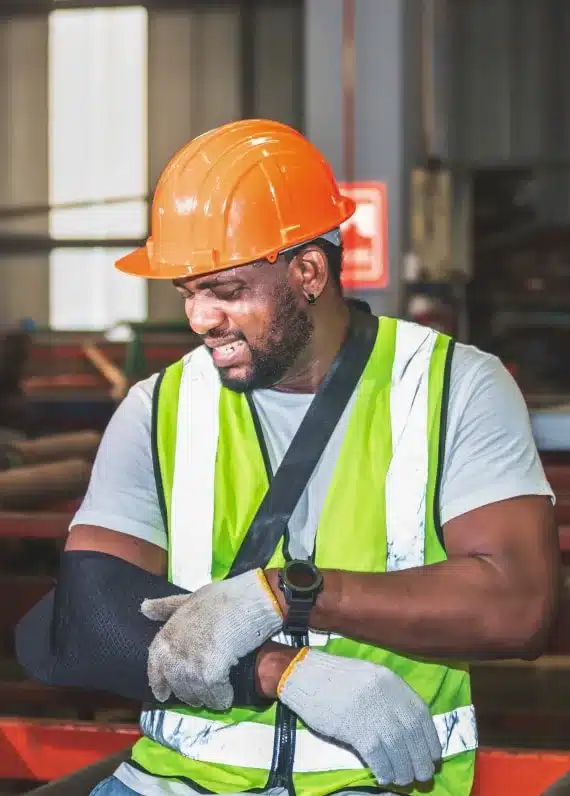
Mixan Mahony, LLC represents construction workers and other employees hurt on Chicago job sites in third-party injury claims against general contractors, subcontractors, property owners, and equipment makers. These claims are separate from workers’ compensation and are generally filed in the Law Division of the Circuit Court of Cook County. For work injuries elsewhere in the state, see our Illinois work injury lawyer page.

Table of Contents
Who besides my employer can be responsible for a Chicago work injury?
Workers compensation is the exclusive remedy against your employer, but other companies whose carelessness caused the injury can be sued. On Chicago job sites that often means a general contractor, subcontractor, property owner, or equipment maker. A third-party lawsuit can pay for pain and suffering, which workers compensation does not cover.
When a Chicago Work Injury Lawyer Can Help Beyond Workers Comp
Illinois law generally bars injured workers from suing their own employer, because workers compensation is the exclusive remedy against the employer (820 ILCS 305/5(a)). That protection does not extend to other companies whose carelessness caused the injury. In Chicago work injury cases, those third parties often include:
- General contractors and subcontractors on high-rise, transit, and infrastructure projects
- Property owners and building managers
- Manufacturers of defective machinery, scaffolds, ladders, or forklifts
- Drivers and trucking companies, when you were hurt on the road for work
- Maintenance, security, and equipment rental contractors
Work Injuries We Handle in Chicago
- Falls from scaffolds, ladders, roofs, and floor openings
- Struck-by injuries, including falling objects and crane accidents
- Trench and excavation collapses
- Machine, forklift, and power tool injuries
- Vehicle crashes while working, including delivery and rideshare driving
- Electrocution and burn injuries
How Illinois Law Treats a Chicago Third-Party Work Injury Claim
Control of the work on construction sites
Illinois repealed the Structural Work Act in 1995, so most construction injury cases are now negligence claims. Illinois courts often look to Section 414 of the Restatement (Second) of Torts, which asks whether a general contractor or owner kept enough control over the work to owe a duty of care to the injured worker. Safety meetings, site rules, and the power to stop unsafe work can all matter. For related cases, see our page on Illinois work injury claims statewide.
Comparative fault
Illinois follows modified comparative fault. Your recovery is reduced by your share of fault, and you cannot recover if you are found more than 50 percent at fault (735 ILCS 5/2-1116).
The workers compensation lien and employer contribution
If you recover from a third party, your employer or its insurer is generally entitled to be repaid the benefits it paid, less its share of fees and costs (820 ILCS 305/5(b)). A third party may seek contribution from the employer, but under the Illinois Supreme Court decision in Kotecki v. Cyclops Welding Corp. (1991), that contribution is generally capped at the employer’s workers compensation liability. These rules shape settlement, so both claims should be handled together.
Deadlines
Most Illinois personal injury lawsuits must be filed within 2 years of the injury (735 ILCS 5/13-202). Claims involving construction design or work may also be affected by 735 ILCS 5/13-214. The workers compensation claim has its own deadline, generally 3 years from the accident or 2 years from the last payment of benefits, whichever is later (820 ILCS 305/6(d)). Call early so no deadline is missed.
What to Do After a Work Injury in Chicago
- Report the injury to your employer in writing. Illinois generally requires notice within 45 days (820 ILCS 305/6(c)).
- Get medical care and tell every provider the injury happened at work.
- Photograph the scene, the equipment, and your injuries.
- Write down the names of witnesses and of the other companies working on site.
- Do not give a recorded statement to another company’s insurer before you talk to a Chicago work injury lawyer.
- Keep your pay stubs, medical bills, and every letter about your claim.
Why Chicago Workers Call Mixan Mahony
Our office is at River Point, 444 W. Lake St., Suite 1707, in downtown Chicago. We represent injured workers throughout Chicago and Cook County, and we coordinate with your workers compensation attorney so both claims move together. If you were hurt outside Chicago, see our Illinois work injury lawyer page. If a family member died after a workplace accident, our Illinois wrongful death lawyer page explains the claims available to the family.
Where Chicago Work Injuries Happen
Chicago’s construction sites, warehouses, rail yards, hospitals, and high-rise buildings produce a steady stream of serious work injuries. Falls from scaffolds and ladders, crush injuries from forklifts, injuries from defective equipment, and vehicle crashes during work travel are common. Many of these sites have several companies working side by side, which is why a third-party claim may be possible.
When a worker is hurt by a company other than their employer, such as a general contractor, a subcontractor, an equipment manufacturer, or a property owner, Illinois law may allow a negligence lawsuit against that company in addition to workers’ compensation.
Cook County Law Division Cases
Most Chicago third-party work injury lawsuits are filed in the Law Division of the Circuit Court of Cook County at the Richard J. Daley Center. Construction negligence cases often involve multiple defendants, contracts that assign safety duties, and indemnity disputes between the companies. Early collection of the site contracts, safety plans, and incident reports helps identify who controlled the work.
OSHA Records and Their Limits
An OSHA investigation can produce citations, inspection photos, and witness interviews. These records can be useful, but OSHA rules do not create a private right to sue, and a citation is not the same as civil liability. We use OSHA findings as part of the evidence, alongside site safety rules and industry standards, to show what the responsible company should have done.
Protecting Your Workers’ Compensation Claim at the Same Time
Workers’ compensation claims are handled by the Illinois Workers’ Compensation Commission, while third-party lawsuits are handled in court. The two must be coordinated, because the employer’s compensation carrier generally has a lien on third-party recoveries under 820 ILCS 305/5(b). We work with your compensation attorney, or refer you to one, so both claims move forward without one undermining the other.
Common Third-Party Defendants on Chicago Job Sites
- General contractors that controlled site safety
- Subcontractors whose workers created a hazard
- Manufacturers of defective scaffolds, lifts, or power tools
- Property owners who retained control over the work
- Drivers and companies in work-related vehicle crashes
Identifying every responsible company matters because the employer generally cannot be sued directly, and the third parties are often the only source of compensation beyond workers’ compensation benefits.
Chicago Construction and the Retained Control Rule
Illinois courts often apply section 414 of the Restatement (Second) of Torts in construction cases. A general contractor or owner that retains control over how a subcontractor’s work is done can be responsible for injuries caused by unsafe methods. Contracts, site safety plans, daily logs, and who ran the safety meetings help show how much control a company actually had.
If you were hurt on a Chicago job site, report the injury to your employer in writing, get medical care, and keep a list of every company working on the site that day.
For related claims, see our Illinois personal injury lawyer and wrongful death lawyer pages.
Chicago Work Injury FAQs
Can I sue my employer for a work injury in Chicago?
Usually not. Workers compensation is generally the only remedy against your employer. You may still sue other companies whose negligence caused your injury, such as a general contractor, property owner, or equipment manufacturer.
Can I collect workers comp and file a lawsuit?
Yes. You can receive workers compensation benefits and pursue a third-party claim at the same time. The employer is generally repaid from the third-party recovery, which is why the two claims should be coordinated.
How long do I have to file a Chicago work injury claim?
Most third-party lawsuits must be filed within 2 years of the injury. Some construction claims and claims against public entities have different or shorter deadlines, so talk to a lawyer as soon as you can.
What does it cost to hire a Chicago work injury lawyer?
The consultation is free, and there is no fee unless there is a recovery.
Talk With a Chicago Work Injury Lawyer Today
Call (312) 262-3971 any time, 24 hours a day, or contact us online to speak with a Chicago work injury lawyer. Get directions to our Chicago office. No fee unless there is a recovery.


